|
Phrae or "Wiang Phrae" is as old as Chiang Mai and Nan. It served as the junction city of the Lanna Chiang Mai and Sukhothai kingdoms
around 700 years ago. Phrae was once ruled by the Khmers who named it 'Kosai City' or 'Kosiya Nakhon'. Following the decline of Khmer influence, the name of the city was changed to 'Muang Pae', City of Victory. 'Pae' in the central Thai dialect has become "Phrae" today.

Ubosod Wat Pha Non
The most revered historical structure in Phrae is Phra That Chahae. It is said that the word 'Chahae' may have been derived from Chophrae', meaning a small silk flag. The Phra That Chahae is believed to contain some of the Lord Buddha's hair, and the presentation of a small silk flag
to this sacred shrine, in the past, was considered highly meritorious among Buddhist.

The North arch way of Wat Pong Sunan
Phrae is known as the best place for the production of the 'Mohom' northern style shirt. In a move to revive the local cultural identities, some government agencies in northern Thailand have urged government officials and company employees to wear the traditional Mohom shirt while in the office once a week, on Fridays.
Another identuty of Phrae is that the city is rich in teak. Many large hotels and houses of the wealthy, in this province, are made of golden tek, and decorated with intricately carved wood. Due to the abundance of teak in this province of the Yom River basin, such foreign firms as British-based Bombay Burma, and Danish-based
East Asiatic Company sought concessions for logging in the province during the reign of King Chulalongkorn. Phrae has, thus, become the site of Thailand's first forestry school.
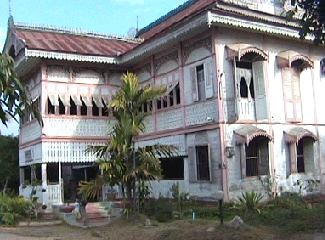
Wong Buri House
Phrae, the town of famous Cho Hae Buddha's relics and Phae Muang Phi, being the site of Muang Song as mentioned in the literature "Lilit Phra Lo" has an overall area of 6,538.6 square kilometers, is located 551 kms. from Bangkok, administratively divided into 8 Amphoes: Muang, Rong Kwang, Long, Wang Chin, Song, Sung Men, Den Chai and Nong Muang Kai.
|


